Democracy, Whiskey, Sexy, Dead

Shamia Rezayee, a veejay on a newly resurgent Afghani TV network, is dead. Why? They think it's because of her job.

two months ago her bosses were forced to dismiss Ms Rezayee, 24, under pressure from conservative mullahs who were disgusted by the “unIslamic values” of her music show.

This week she paid for her unconventional choices with her life: she was shot dead in her home by an unknown assailant.

Police said that they believed the killing was linked to her former job as a “veejay” — video journalist — on Hop, which was broadcast by Tolo TV, one of a number of private stations set up since the fall of the Taleban.

I just finished Asne Seirstad's The Bookseller of Kabul, in which the European journalist author lived with the family of a bookseller in Afghanistan for a few months. Although the book is eye-opening for other reasons in that it is a doorway into a culture and civilization that the Americans never see intimate details of, it is positively eye-popping for its descriptions of how women are treated. In the words of Jeffrey Lebowski, "he treats objects like women, maaan!" The bookseller's first wife, tossed over for his second wife, is reduced even further to cipher status within his household, newly subordinate to the illiterate and bubbleheaded hottie from the sticks. The bookseller's youngest daughter, an intelligent girl who learned English while in exile in Pakistan tries to find some way to teach English in a nearby school while still seeing to the every bodily need of all nineteen people in her household. She is the last one to bed at night and the first one up in the morning, and she had better make sure breakfast is waiting when everyone else stirs. Her hopes fade when she is married off- to a nice enough man, to be sure, but no married woman is going to go teach English. It's makin' babies time. Throughout the book, women are treated as chattel, as ciphers, as halfway to slaves - and this in the house of a literate, urbane and worldly patriarch with modern inclinations. Though the book is ostensibly about the bookseller and his travails, and about half the book is in fact spent discussing his troubles with the Taliban, his business, and his aspirations, Seirstad clearly finds more compelling material in the lives of the women around her. And this is probably as it should be as the book ends up pitting the struggles of one man to rescue his country from the dark ages against his struggles to maintain the dark ages in his own home.

As Hamid Karzai said on September 10, 2001 when hearing of the death of Northern Alliance leader (and last hope against the Taliban) Ahmed Shah Massoud, "what an unlucky country." (If there is a prize for bitter historical irony of the century, we have probably found our winner.) I recently finished Steve Coll's Ghost Wars: The Secret History of the CIA, Afghanistan, and Bin Laden, from the Soviet Invasion to September 10, 2001 as well, and the political picture of the country that emerges is one of an ancient and noble set of tribes crippled by internecine rivalries, Islamism, greed, and the distorting effects of international meddling. The CIA and Pakistani secret service took turns acting as unwitting catspaws for each other with the effect that by the time the Taliban came roaring across the plains they were driving nice new white Toyota extended-cab pickups courtesy of Langley, VA and invading areas denuded of worth and reduced to chaos courtesy of equal parts Moscow, Langley, and Islamabad. Although Coll's history is necessarily myopic, focusing as it does on the arc of the CIA's involvement in the country, I learned a lot in the process about the texture of Afghanistan's geography and ethnography and that part of Asia in general. Did you know that the name "Hindu Kush mountains" means "Hindu Killer?" Together with Sierstad's book, the picture that emerges is of a set of borders without a country; a people with a history but no common future; and a region with boundless initiative and an eye for the main chance but no constructive ideas.

A nation that has come to rely heavily on violence as a means of resolving disputes and still can't agree whether women showing their faces in public is a hanging crime or simply unseemly has a long way to go before it can get anywhere. What is especially puzzling is why this must be the case for a civilization so old, so rich, and so centrally located on ancient trade routes.

[wik] On another note, I am working on a piece on the intersection of political violence and popular music that I hope to have up sometime soon.

[alsø wik] This serious and utterly unsnarky post has also been books #11 and #12 in The Fifty Book Challenge.

Posted by Johno Johno on   |   § 0

Womyns and fairies fighting for truth, justice and the American way.

Max Boot, author of The Savage Wars of Peace: Small Wars and the Rise of American Power (a fantastic book I can't recommend highly enough), has an op-ed in the LA Times about the dispute surrounding the role of women and gays in ground combat. If you'd asked me to guess how Boot came down on this issue, I'd have probably guessed he was against, but here he makes a strong argument for the integration of women and gays into frontline Army and Marine units.

But today, 212,000 women (15% of the active-duty force) play an integral role in the military. Keeping them out of combat is impossible, whatever the law says, because in a place like Iraq everyone is on the front lines. Thirty-five female soldiers have died in Iraq and almost 300 have been wounded.

Even as women have taken on roles once reserved for men, the disastrous consequences predicted by naysayers have not come to pass. In 2000, the late Col. David Hackworth wrote: "What the British longbow did to the French army at Crecy in 1346, the failed military policy on gender integration has done to the U.S. armed forces at the end of the 20th century: near total destruction." Yet in the last five years, "near total destruction" has been the fate not of the U.S. armed forces but the Taliban and Baathists they have battled.

... I also don't see why we are still barring all gays and lesbians from serving openly. Between 1994 and 2003, according to the Government Accountability Office, the military discharged 9,488 homosexuals, including 322 with badly needed knowledge of such languages as Arabic, Farsi and Korean. In other words, the fight against gay rights is hurting the fight against our real enemies. That's a compelling reason to change the law, even for those of us who used to be supporters of the gay ban.

I have in the past, like Boot, supported the ban on gays in the military. Like him, I was persuaded by the arguments of those opposing the ban that the mere presence of gay soldiers or marines would undermine morale and unit cohesion.

There certainly isn't any historical basis for banning gays from serving, and serving well. All the way back to the Sacred Band of Thebes, gays have often had a prominent role in combat. Our culture has had a long history of discrimination, if not revulsion, aimed at homosexuals; and it would not have made sense to sacrifice the fighting efficiency of the vast majority of straight soldiers to allow a relative few gays to serve. However, attitudes have continued to change, and I think that that argument no longer holds water, especially given the increasingly difficult task of maintaining recruiting levels, and attracting needed skills into the armed forces. We should eliminate all restrictions on gays serving in the military, and if necessary (though I think it won't be) implement the kinds fo policies that were used to integrate blacks back in the fifties.

Women are now in combat pretty much across the board. They are fighter pilots in the Navy and Air Force, and serve on warships in combat duty. They serve in support and combat service support roles in both the Marines and the Army, and the nature of the conflict in Iraq - largely absent of any traditional battle lines - means that they are on the front line no matter what DoD classification they have. That's all well and good. Boot's argument however, is that since they're already in combat, there's no point in making any sort of distinction at all. That's doesn't necessarily follow, though I admit that pulling women out of support units would be an enormous headache.

I don't think that women who volunteer for the armed services are necessarily lacking in the "fighting spirit" or "killer instinct" that male soldiers supposedly possess. A lot of evidence points to the fact that the majority of men in the armed forces are not natural born killers, and attempts to make them such are not very successful. Some sort of 80-20 rule seems to be operating - a large percentage of enemy deaths are likely caused by a relatively small number of American fighters. There is no inherent reason that women can't be in either group, and it is clear that both are needed for a successful military. (We might imagine that relatively fewer women will be in the natural killer category, but self selection would allow lots of them to end up in the military.)

My only real remaining problem with women in combat is the physical requirements, which are currently (to my understanding) significantly lower than for men. Raise those standards, at least for women wanting to serve in the Airborne or other elite units, and I'm cool with the whole project. I don't think the young straight men in the Army and Marines will have a problem with that, as long as they know their new comrades are going to be able to pull their own weight.

Really, we should do this not just because it fits in with our whole free-wheeling, I'm okay - you're okay American idiom. Just think about the salt and lemon juice rubbed into a paper cut feeling it would induce in an already pissed off jihadi to be captured by a squad composed largely of women and gays. That'll stick a spoke in their wheel.

Posted by Buckethead Buckethead on   |   § 1

The geek in me is crying

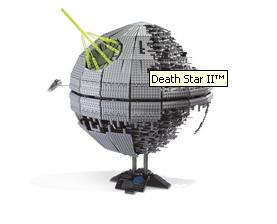
Lego corp, that evil capitalist monstrosity, has released for sale a lego version of the second Death Star:

Lego Death Star

Those bastards couldn't make all these wonderful toys back when Star Wars and Empire Strikes Back were around, could they? Noooo, not when I was a kid. My two favorite toys when I was a lad were legos and star wars action figures. But the two sets of toys were mostly incompatible. How I yearned for Star Wars Legos. I wrote them a letter. Bastards! Now I'm too old and my son's too young. Crap!

@#!?%!

Posted by Buckethead Buckethead on   |   § 7

Further additions to the blogroll

The Ministry is happy to announce the promotion of Pittsburgh Steeler fan (nobody's perfect) and irascible conservative John Cole of Balloon Juice to the Ministry Legion of Merit. His trenchant commentaries and clear-eyed indictments of buffoonery from all quarters will make him a useful adjunct to our political wing. This move is also long overdue and by way of recompense the Ministry is pleased to offer to Mr. Cole the head of any enemy of his choosing, on a stick, for his enjoyment.

That is all. Thank you for your cooperation.

Posted by Ministry Ministry on   |   § 0

Don't get smug

Once again, Instapundit can suck it:

Thus speaks a true Minnesotan [Lileks]. It's unseasonably cool here, too. But that means 70 degrees.

Heh. Indeed. Read the whole thing.

Last night I slept (failed to sleep) in a breeze for the third straight night as a nor'easter pounded our house (situated on the north face of the second highest hill in town) with 60-mph winds and horizontal rain. The wind came straight through the window and into the room, the backyard fence blew down, and I can't get the storm windows back down since all the windows on one side of the house are swollen shut thanks to rain. And yet they let the air right in. Go figure. Since Monday, every night has been like trying to sleep in the baggage hold of a passenger jet, it has rained every day for eight days and four successive weekends, and it is expected to rain for another week straight. Massachusetts has been setting record lows this week. It's Memorial Day and this week the temperatures have been 45, 48, 50, and 52. If we could some how get rid of every last person in Florida I'll move there in a second, at least until it stops threating to snow in June.

You know, sometimes the snow comes down in June. Sometimes the sun goes 'round the moon. And sometimes you want to gouge your eyes out with a spoon.

Posted by Johno Johno on   |   § 2

The Low Spark of Son Volt

When Jack White teamed up with Loretta Lynn last year for Lynn's (don't call it a) comeback record Van Lear Rose many critics - including me - rushed to hail the return of rock to country and country to rock. While I still maintain that Van Lear Rose is a very fine record that picks up where Gram Parsons and Sticky Fingers left off, I have to admit to engaging in a certain amount of revisionism in my review. Rock and country never really broke up in the first place.

Country-tinged rock has always been there on the margins, if you knew where to look. Even in the skinny-tie 1980s, Green on Red were tie-dying their Nudie suits, and through the 1990s Neil Young was releasing now-classic albums like Freedom, Ragged Glory (which led off with a track called "Country Home''), Harvest Moon, and the double-live Weld. The Jayhawks have been making harmony-drenched roots rock since the days of Def Leppard. And most notably (from a rock snob perspective), the No Depression scene of the early 1990s fostered the careers of bands like country punks Uncle Tupelo and that band’s descendents Wilco and Son Volt. While Uncle Tupelo veteran Jeff Tweedy drove Wilco away from rootsy rock into arty and critically acclaimed experiments, his bandmate Jay Farrar chose to tow the country-crunch line in Son Volt.

Best known for their 1995 college-radio hit "Drown," Son Volt released three albums of guitar-driven roots rock (what would now be dubbed "Americana") between 1995-1998 and then went on semi-permanent hiatus. (There is a new Son Volt album out this year, but Farrar is the only original band member remaining.) Anchored by Farrar's reedy voice and his concisely stated guitar lines, 1995's Trace (Warner Bros.) didn't so much depart from Uncle Tupelo's sound as much as bear down on the rough parts. Subsequent albums, 1997's Straightaways and 1998's Wide Swing Tremolo (both also on Warner Bros.) introduced jangly midtempo alt-rock into the mix to (what some say were) diminishing results.

For a band with only three full-length albums under its belt, Son Volt have cast a long shadow. Although now perceived as Megadeth to Wilco's Metallica, the slightly ragged, plaintive sound they pioneered is now classic, and echoes can today be heard in every third track on Adult Alternative radio. Thus, the time is right for Son Volt - A Retrospective:1995-2000, just released on Rhino.

It is a little puzzling as to who Retrospective was intended to please. Although the compilation starts out strongly with four excellent selections from Trace and a worthy bonus song and proceeds chronologically from there, this otherwise logical scheme inadvertently points out Son Volt's weaknesses as much as plays to the band's strengths. Thus, the running order risks turning off newcomers. On the other hand, Rhino chose to make fully half the selections an odds-and-sods mix of EP, soundtrack, and unreleased offerings, suggesting that this collection is aimed at diehard fans. The trouble is that diehard Son Volt fans (I know a few) are the type most likely to have already hunted down promo EPs and bought the soundtrack to the 1996 grungesploitation flick "Feeling Minnesota" just for the one Son Volt song.

So, what are those strengths and weaknesses that emerge? And are the unreleased bits worth it? Well, first things first. Jay Farrar is a heck of a songwriter, with a strong sense of structure and melody. The guitar work in particular walks the line between Marshall crunch and country twang. The band display an admirable sense of epic restraint that keeps them from spiraling off into eight minute Jay Mascis jams, as if Neil Young (circa Zuma and Bruce Springsteen (circa The River) were writing songs for Nashville. On the quieter numbers, Farrar’s country side generally turns his introspective and melancholy lyrics into universal laments, which is the hallmark for all good country ballads.

However, these same tendencies get the band in trouble. The same restraint that keeps the hooks hooky and the songs short leads the band to try the same tricks repeatedly with the result that their style doesn’t seem to evolve as much as flatten from one era to the next. Though excellent songs appear from all three albums, Farrar over time seems to succumb to the dreaded Mid-Tempo Syndrome where every song stays timidly in a neat little box. That's not to say that Jay Farrar doesn't have a singular and beautiful way with those pretty country gems: on the contrary, he does. But a collection of such songs back to back to back would be as interesting as tan wallpaper no matter how good any single song might be.

The running order ultimately saves Retrospective from petering out too quickly. For example, although track nine, a previously unreleased acoustic cover of Woody Guthrie's "I've Got To Know," is okay, if it were sitting between the mild midtempo of "Back Into Your World" and the downcast "Creosote" (both from Straightaways), even the most dedicated fan would be fast asleep. Since this is the point at which the disc seems to enter its second act, it’s important that this not happen. Luckily, the compilers keep the energy up by puttin the excellent (and loud) "Picking Up The Signal" from Straightaways between "World" and the Guthrie song. Similarly, wonderful gems like "Windfall," "Rex' Blues" (a compilation track with Kelly Willis) and "Tulsa County" gain by being paired with the more uptempo "Drown," "Route," and "Straightface." This dynamic holds through the first two-thirds of Retrospective.

Still, for listeners unconvinced of the genius of Gram Parsons, the band's quieter moments finally threaten to bog things down in a somber haze that intelligent programming can’t fix. This tendency is especially pronounced in the disc’s third act. The last ten tracks alternate between selections from Wide Swing Tremolo and various unreleased and rare tracks. Unfortunately, the selections from Tremolo smear together into a slightly bland mess of REM-ish pleasantness, and the sketchy and diffuse bonus cuts don't help matters. A desultory Lead Belly cover ("Ain't No More Cane") slouches by between two moody album cuts, and by the time we reach the mournful cover of "Holocaust" from Big Star’s glorious wreck of an album, Third/Sister Lovers, Retrospective feels more like a funeral than a party.

The compilation closes out with a few demos, a live track, and a cover of Springsteen's "Open All Night," from Badlands: A Tribute To Bruce Springsteen's Nebraska. The band's performance on the Springsteen song underlines what bothers about the whole second half of the disc. Although Farrar does his best Springsteen impression and the band keep pace with pleasant and tasteful noises, the song ends up feeling a bit listless and empty, like an unfinished throwaway.

Although Son Volt - A Retrospective:1995-2000 is a worthwhile introduction to the band’s career, it remains trapped between its twin obligations to the newcomers and the dedicated. The first half is uncommonly strong (and on its own worth the price of admission) but by the end Son Volt come across not as ahead-of-their-time Americana visionaries but as a band hemmed in by their influences who didn't risk a grand display if a modest gesture would get them by.

(This post also appears on blogcritics.org, which you should be reading daily.)

Posted by Johno Johno on   |   § 0

For your eyes, but only if you can find it

While I'm on the subject of writers, writing, and reading, the Guardian has interviewed Umberto Eco about his new book as well as the difference between Foucault's Pendulum and The Da Vinci Code (other than the obvious gulfs of quality, erudition, and depth) and whether he is the Italian Salman Rushdie. Thanks to the squishy lefties at bookslut.

Posted by Johno Johno on   |   § 4